One world, one English, please! The need to communicate concisely and clearly in these times of instant everything has never been greater. English has become the common ground and an excellent tool to help people from all points on the compass understand one another.
Native or second language, we all need help to convey our messages effectively and efficiently. This blog will discuss the issues involved in communicating in the multilingual, multicultural world of the 21st century.
Desserts, we do love them. And English, you have to love it too. I definitely do or else I would find myself in tears at times with the many little annoying nuances of the language. Let’s look at some examples of phrases that differ just ever so slightly.
First, a personal favorite, but not an actual phrase with any specific idiomatic sense, is “just desserts” as in “this menu contains just desserts”. I presume that this statement would be in reference to a separate dessert menu at some posh restaurant. Skip the main course and proceed directly to the main event, please!
Next we have the phrase (idiomatic indeed) “just deserts,” but this spelling of “deserts” does not refer to the large expanses of sand devoid of vegetation. The phrase “just deserts” is defined by Oxford as “what a person deserves with regard to reward or (more usually) punishment.” The Macquarie Dictionary (the pride of Strine) defines the phrase as “a misfortune or punishment viewed as being richly deserved.” And Webster’s New World Dictionary, 4th Edition, concurs … “deserved reward or punishment.” So that’s good. At least we English speakers on all sides of the Atlantic and Pacific agree on the basic idea. But based on the pronunciation, it is easy to see why we confuse the spelling of deserts and desserts when referring to the “deserved reward or punishment.”
Checking several sources it appears that “just deserts” was in print for the first time in 1599. Spelling rules were somewhat less strict, or non-existent, at that time. The etymology of the noun phrase is circa 1300, from Old French deserte, used as a noun from the past participle of deservir “be worthy to have.” Here’s where the original spelling with one “s” entered English. The noun “desert” (wasteland) derived more directly from Latin as desertum (desert).
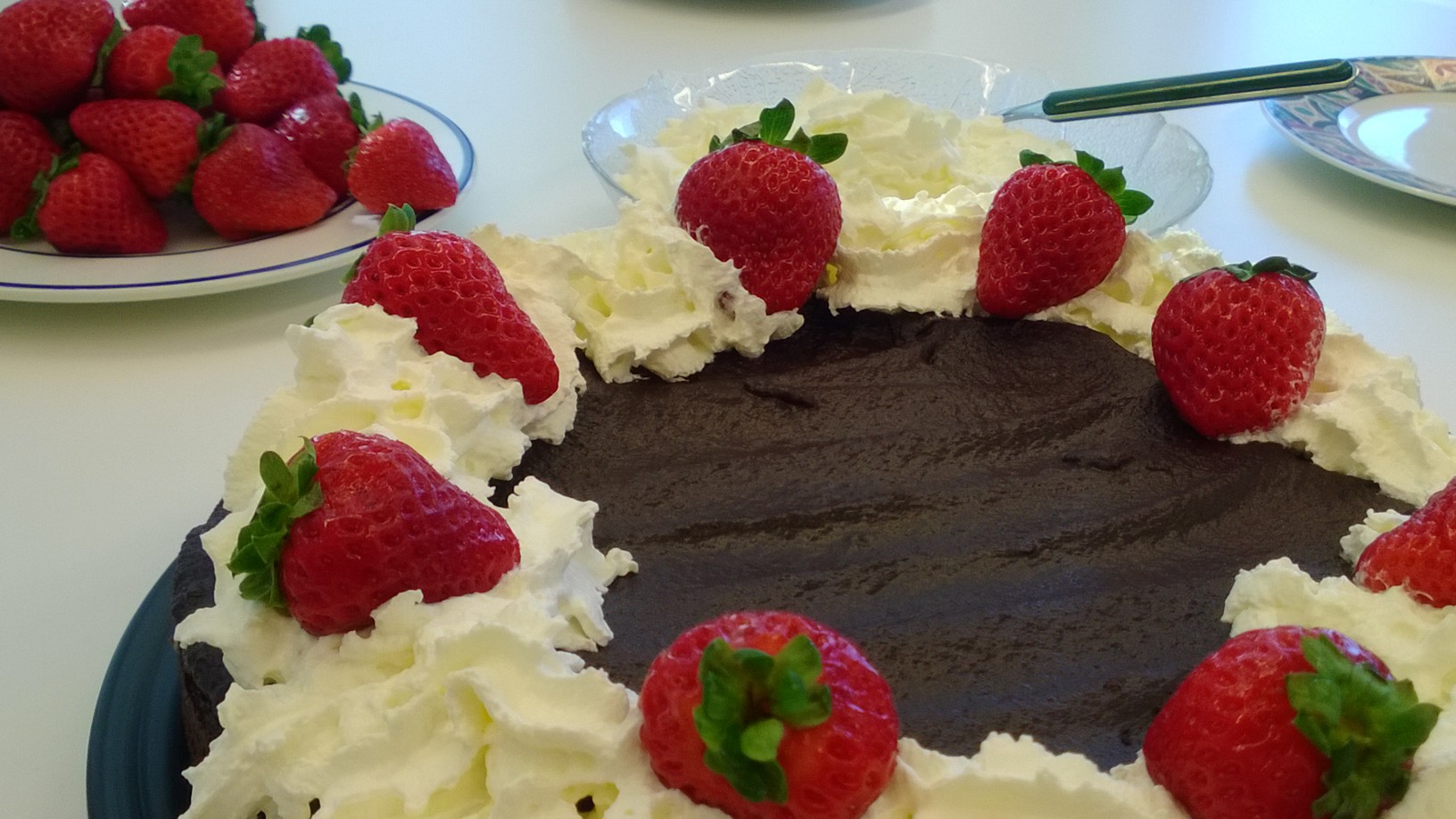
But back to the pronunciation; the phrase “just deserts” is the same as “just desserts” (the after-dinner delight). We pronounce the noun “deserts”, the treeless expanses of desolation with little or no water, with an accent on the first syllable, but not so in the phrase “just deserts” where the accent is on the last syllable and hence the same pronunciation as the noun “dessert”.Probably why we spell it incorrectly so often. The idiomatic use of “just deserts” is pronounced exactly like the chocolate confection pictured above, but is spelled like the “dry wasteland.” By the way, the verb “to desert” (forsake, abandon, leave) has the accent on the second syllable too, so it also sounds exactly like the yummy noun “dessert”.
Confused? Yes, me too, and every poor soul who tries to learn English as a second or foreign language.
Of course there are instances where you might want to write “just deserts” when referring to the Sahara, Gobi, Kalahari, etc. But the frequency of these two words together in this context, with the concrete meaning of land formations, would be somewhat contrived or artificial.
Couldn’t we make a case for changing the spelling to “just desserts” as being a reward? Desserts are usually a reward, seldom a punishment though. I suspect that, to quote Bob Dylan, the times are a-changing for this phrase. Many changes in the language are the result of a misspelling or misinterpretation of a word or phrase; often common usage eventually wins out. Click here for more about how Oxford University Press determines when to accept changes. If we were to change the spelling of the phrase to “just desserts” though, then the meaning might begin to change too, and the sense of punishment (the more prevalent one, and in fact, it seems the only one in Macquarie Dictionary) might be lost. Food for thought. Apologies for the pun. But there is some hope. Many dislike the use, or at least overuse, of what they consider stale and trite expressions such as “just desserts”. So the best solution. Avoid them. Save the idiomatic use for your social media pages or blog. Thus the only instances of “just deserts” will be in articles on travelling the world’s wastelands and “just desserts” only in restaurant reviews
In English, casing is most definitely a challenge. In the sentence below casing is the only key to disambiguate meaning – correct use of casing, of course.
Representatives from the New Mexican government disagreed with the position of the new Mexican government regarding border crossings.
The (not new) Mexican Flag
This sentence is perfectly plausible given their physical contiguity and political convergence. And be assured, the seemingly capricious or mercurial nature of English is steeped in semantics; meaning is essential to mastering and communicating accurately in English – dare I say, any language.
Correct use of prosodic elements (sentence intonation and stress) usually solves misinterpretation in speech since the speaker would (or should at least) stress the first syllable in new Mexican but the second in New Mexican. Casing is one way to indicate this difference when we write.
If the Mexican case were a one-off, it could be handled quite easily. However, there is a plethora of “New”s in English … a short list includes New York, New Jersey, New Hampshire, New England, New France, New Spain, New Caledonia, New Orleans, New Zealand, New Delhi, New Age, New World and the list goes on and on.
When the two (New Mexico and new Mexico) occur together in a sentence or article, it is rarely problematic; the writer is conscious of the difference and hence more observant. However, confusion can arise when they appear individually.
That’s a brief look at casing for now … which seems more like a stroll through the garden compared to apostrophes – and the ultimate mind-boggler – the hyphen. Just to tantalize a bit, a mere mention – there’s read-option and re-adoption, and the Phillips screwdriver but Phillip’s screwdriver (which means we could also talk about Phillip’s Phillips screwdriver) … but let’s return to those topics later in future blogs. I think we can say with great certainty that we are not at a loss for topics about the pitfalls, the anomalies of language, especially English.
What are the AABC’s of English? Basically, and with a bit of creative license (or licence), I mean American, Australian, British and Canadian English, in alphabetical order. Of course. And further discussion is warranted as we move about the world and incorporate more varieties of English including Chinglish and Hinglish. Then there are also their cousins Franglais and Spanglish. But these are not particularly official languages, albeit widely spoken in Canada, the Cameroons, the US, Mexico, among other places.
If we only consider the official varieties, we still have a fair chunk to digest. Currently there are well over 75 countries and about half as many non-sovereign areas where English has an official or special status
While English is only the third largest language relative to native speakers, following Chinese and Spanish, it is the world’s largest language given the total number of speakers. Most estimates put the total number of English speakers in the world at 1.5 billion. If you are interested, the British Council discusses additional facts here about the de facto use of English throughout the world today. And the internet is affecting the situation.
The latest version of the world’s most used word-processing program lists 18 versions of English. But those aside, we have plenty of grist with just the Big 4 – the AABC’s of English.
We call these varieties dialects of English, not affording them full language status. But is our perception changing? I see as many indices for pulling apart as for coalescing into one variety. What often happens in language contact situations is a clear division in speaking one variety in public and the other at home. Many of my fellow native English speakers admit that they speak a broad form of English in mixed international crowds, slipping into their own dialect among family and friends. And I swear that when I watch the BBC or euronews many of the UK politicians sound far less British than before – sort of “New England American” with flourishes of Oxfordian.
At least one variety?
And although English began in England, hence the obvious name, beyond a doubt English now belongs to the world. In fact, there are rumblings of many competing new monikers including Globish, World English, International English, Global English, etc. It appears that Wenglish (which could have been an abbreviated form of World English) is already taken by Welsh English. And Globish is increasingly referred to as the English spoken by non-native speakers to communicate on a global basis. But no worries. I suspect that we English speakers will have as much difficulty agreeing upon a new name for an international variety of English as we do in trying to agree on the spelling of English.
Language changes: spelling, grammar, morphology, punctuation and style. Nor can we ignore the social and cultural differences that exist. I think it was best said by Mark Twain and sums up some of the positions we need to acknowledge:
An Englishman is a person who does things because they have been done before. An American is a person who does things because they haven’t been done before.
Or what Dorothy might have said upon entering a patisserie instead of the woods on her way to Oz.
What is a cronut, besides one of the most common words of the past decades on the Internet? Basically, it’s the culinary craze worldwide, born of a French, New York-based chef who ingeniously crossed a croissant and a doughnut (in a bowl of batter, that is).
So what’s the problem? Unlike Dorothy, we have nothing to fear from these creatures – or creations. There’s no problem from a culinary standpoint. Bring them all on. And zonuts and dough’ssants, ok, but Dominique Ansel, the creator of the original cronut, has trademarked the original name, hence the rise (apologies) in variations of nomenclature. Officially it is the Cronut™ and was launched at the Dominique Ansel Bakery in New York City. Since Monsieur Ansel trademarked the name, other chefs have resorted to creating their own names along with as many variations of the recipe.
Down under in Sydney, Adriano Zumbo put his own twist on the creation, and voilà, Zumbo’s Zonuts was the result. Not to be outdone, some Canadian cousins in Vancouver again tweaked the recipe and came up with the frissant – tipping their toques to the French language, and shunning the original term that they felt reminded them of something that “sounds like a disturbed Cro Magnon.”
And what about England … checking for shops offering the crispy delights in London I also came across cro-dough, crodough and crodo – Oh, my! Indeed.
But we are not done yet, linguistically speaking, and here’s where we really start encountering problems. There is yet another variation on the name, and even the spelling: the doughssant or dough’ssant (which has also been spelled dossant and dosant). Seriously, if we are going to evoke French etymologically, and not provoke the French culturally, shouldn’t it be “deaussant”? Or why not “beignssant” (beignet + croissant)?
So there is a plethora of what some have referred to as “cronut knock-offs,” thus the dilemma. Zonut and frissant are valid, and so far, no variations in spelling. Into the dictionary. Then there are the “do” varieties.
In conclusion, no matter how you spell it, a doughnut-croissant by any other name would taste as sweet. Thanks for your innumerable contributions to our “linguistic confections,” Will S.!
Only in grammar can you be more than perfect. William Safire
And all dared to brave unknown terrors, to do mighty deeds, to boldly split infinitives that no man had split before—and thus was the Empire forged. Douglas Adams inThe Hitchhiker’s Guide to the Galaxy
The past is always tense, the future perfect. Zadie Smith
I really do not know that anything has ever been more exciting than diagramming sentences. Gertrude Stein
A preposition is a terrible thing to end a sentence with. Winston S. Churchill
If rhetoric study was the military, grammar teachers would be the drill sergeants. T.K. Naliaka
Grammar is like your overarching compulsion. It’s math with words. Thomm Quackenbush
The past, the present, and the future walked into a bar. It was tense. Lex Martin
As far as I’m concerned, ‘whom’ is a word that was invented to make everyone sound like a butler. Calvin Trillin
The role of language in politics becomes very evident during elections. For better or worse, language plays a crucial role in the entire process: in debates, speeches, on the Internet.
But what about the politics of language? To what extent is language shaped by or at least restricted or influenced by politics. In 2015 the Washington Post officially adopted the use of the singular “they” – that is, the use of the plural form of the third person to avoid awkward “he/she” or “he or she” constructions. Naturally this also includes the acceptance of the singular “their” in place of “his/her” and “his or her” but read more about it here.
And we have all struggled to find gender neutral terms for occupations: firefighter instead of fireman or firewoman, police instead of policeman or policewoman. These are the politically correct, excuse my triteness, designations for women and men’s occupations in our newest world, or word, order.
After 9/11 there was an attempt to change French fries to freedom fries, following an attempted demotion from French to french fries too. But it appears, fortunately, that there was no permanent consensus and support for these suggestions.
Beyond words, yet another area of language has been affected, namely names. For example, the Islamic group referred to alternately as ISIS or ISIL, or simply IS, for the Islamic State has been revisited. It has been reported that certain world leaders refuse to use any of these names citing the fact that the group is not officially a “state” instead preferring to call the group by the acronym in Arabic: ‘Daesh’.
Inflammatory language: must we fight fire with fire?
The acronym Daesh in Arabic stands for the phrase al-Dawla al-Islamiya al-Iraq al-Sham (or the Islamic State of Iraq and the Levant). In fact, the Islamic group vehemently disapproves of the word. In Arabic there are two very similar words ‘Daes’ (one who crushes something underfoot) and ‘Dahes’ (one who sows discord) which can evoke a negative image in the eyes, or at least ears, of Arabic speakers. Certain world leaders elect to use the word; in the opposite camp, threats are being made to thwart the use of the name Daesh.
Thus we English speakers are bound to acknowledge and be aware of the subtle uses of words, phrases and names that can influence readers consciously or unconsciously. But isn’t that what effective writing is all about? Responsible writing however could incorporate neutral forms to inform rather than infect, incite and ignite. English neutral in all forms seems reasonable, doesn’t it?
A phrase heard often to emphasize the meaning and essence of the word team. Interesting philosophically, but it does have implications for language use too. Namely, is team a singular or plural noun from a purely linguistic point of view?
Actually it varies depending on the variety of English used. Generally in the US, team as well as other words like family and government are traditionally considered singular – a unit that functions as one entity. However, in the UK most speakers adhere to the idea of “notional concord“ – that is, the notion of what is meant. Hence, the family (or team) are means the members of the group while the family (or team) is means the members function as one unit. But to return to the use of “generally“ in the US, things may be changing. Some sportswriters and sportcasters have begun adopting the notional concept and the Miami Heat are and Orlando Magic are have begun to appear in the American media.
As mentioned above, the concept of singular vs plural may be a purely philosophical argument and perhaps these questions should be left to the colleagues and followers of linguistic philosophers such as Paul Grice to address. But from a practical point of view, notional concord may be creating havoc among English speakers in my opinion, especially non-natives. More and more often I hear speakers exposed to notional concord incorrectly using unambiguously singular nouns. With the exception of editors and professional writers, notional grammar may have confused speakers enough to where they just throw up their hands and use whatever form seems handy at the moment. Perhaps the old rules are simply going down the proverbial drain.
And while on the subject of rules, we might consider whether English actually needs singular and plural forms of the verb in the present tense. For example, the Scandinavian languages have a verb structure very similar to English; they are fairly alike regarding the tenses. But the Scandinavian languages do not have the third-person singular “-s“ form in the present tense such as he is, she likes, it has. There is only one form in these cases, which in English translates to the plural forms – are, like and have respectively. It certainly would simplify English grammar, particularly for second language learners of English.
There is a precedence too for this type of reduction or loss. Historically, English with its Germanic roots had two forms of the second person pronoun: you and thou. Except for poetry and Shakespeare, thou (originally the singular) has basically disappeared in favor of you (originally the plural).
Back to the beginning of this discussion, since there is no “I“ in team, does that make team a plural? Or is it a singular, or both? In the same vein, there is no “we“ in government, so is it singular? Or a plural, or both? But that is definitely dangerous territory and does not only relate to language. Philosophical and political indeed.
Each fall the Center for Plain Language in Washington, D.C., grades agencies of the federal government, non-profits and private companies on their efforts to write clearly. Their reports certainly make interesting reading; see the full report card for U.S. government offices here:
Writing in plain language entails many different elements from words and phrases to euphemistic labels and clichés. English is often deliberately made obscure, unclear or overly complex — when the point should simply be to communicate. (But that’s a discussion for another time.)
Let’s begin with a list of some redundant words and phrases, usually labelled pleonasms or pleonastic phrases by linguists — and these labels are themselves perfect candidates for translation to Plain English.
all-time record
record
by means of
by
close proximity
proximity (or ‘is close’)
controversial issue
issue
during the period
during
firstly
first
for a period of
for
herein
here
herewith
here
in an effort to
to
most unique
unique
past history
history
rather unique
unique
reason why
reason
set forth in
in
together with
together or with (but rarely both)
totally demolish
demolish
totally destroy
destroy
The examples above are but one limited category of words that can result in obscure language or just excessive wordiness in writing. Keep checking this blog for some of the other categories.
The Center for Plain Language also publicizes awards annually, winners and losers basically: ClearMark and WonderMark. The name of the second award I dare guess is probably short for I-wonder-what-the-f-they-are-talking-about. You can see the lists of the latest finalists by clicking on the links below::
If you would like to read more about the center and its activities, visit their website here. In summary, it’s plain that we should keep our language clear and not leave our readers to wonder what we mean.
We don’t just borrow words; on occasion, English has pursued other languages down alleyways to beat them unconscious and rifle their pockets for new vocabulary. Booker T. Washington
English is a funny language; that explains why we park our car on the driveway and drive our car on the parkway. Author Unknown
Writing in English is the most ingenious torture ever devised for sins committed in previous lives. The English reading public explains the reason why. James Joyce
If the English language made any sense, lackadaisical would have something to do with a shortage of flowers. Doug Larson
Making English grammar conform to Latin rules is like asking people to play baseball using the rules of football. Bill Bryson
I speak two languages: Body and English. Mae West
Drawing on my fine command of the English language, I said nothing. Robert Benchley
To write or even speak English is not a science but an art. There are no reliable words. Whoever writes English is involved in a struggle that never lets up even for a sentence. He is struggling against vagueness, against obscurity, against the lure of the decorative adjective, against the encroachment of Latin and Greek, and, above all, against the worn-out phrases and dead metaphors with which the language is cluttered up. George Orwell
When I read some of the rules for speaking and writing the English language correctly, I think any fool can make a rule, and every fool will mind it. Henry David Thoreau
English? Who needs it. I’m never going to England. Homer Simpson






 A double negative is a no-no. Author unknown




 OneWorldOneEnglish
