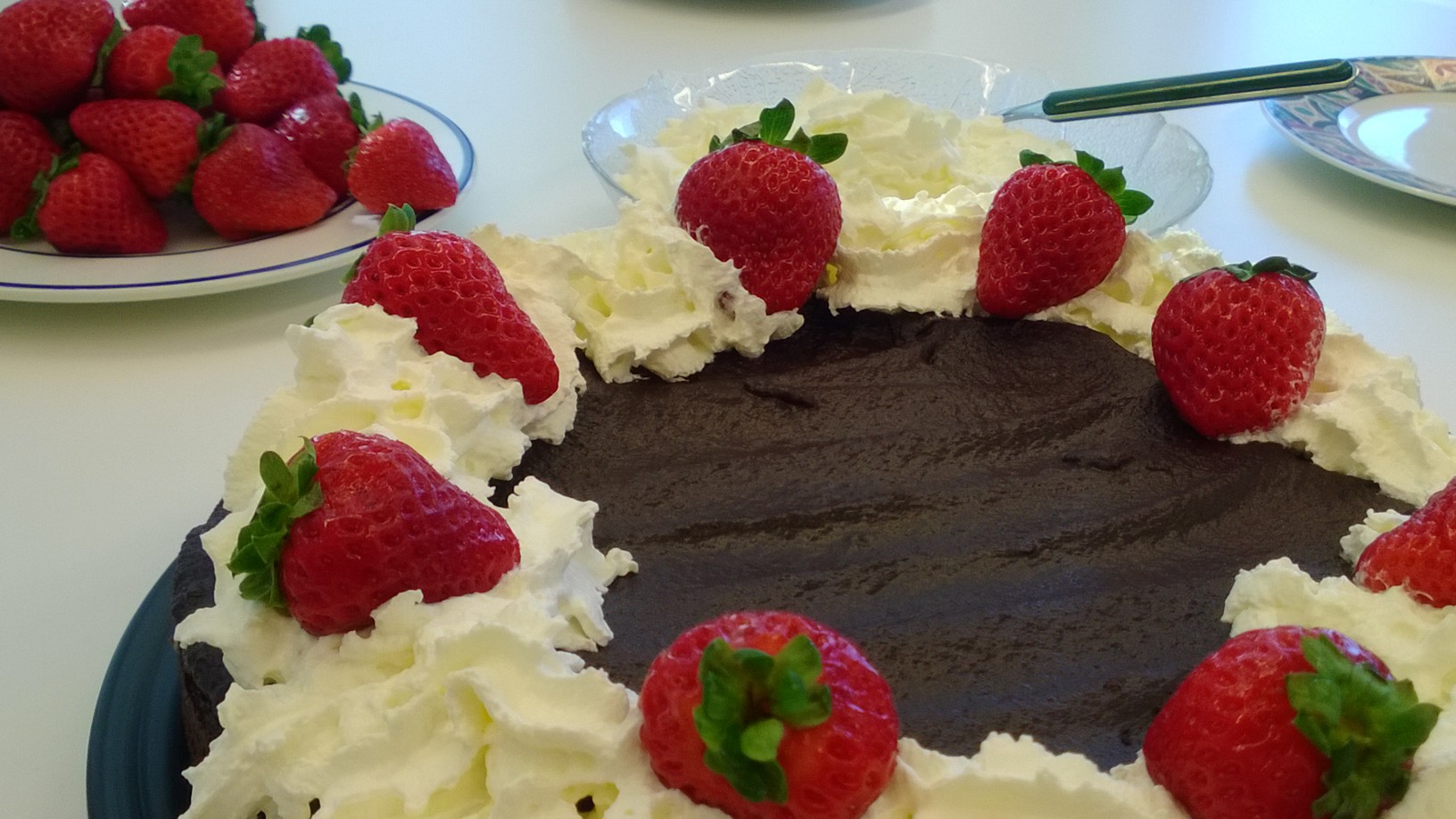
Just desserts

Photo by K. A. Lillehei

Desserts, we do love them. And English, you have to love it too. I definitely do or else I would find myself in tears at times with the many little annoying nuances of the language. Let’s look at some examples of phrases that differ just ever so slightly.

First, a personal favorite, but not an actual phrase with any specific idiomatic sense, is “just desserts” as in “this menu contains just desserts”. I presume that this statement would be in reference to a separate dessert menu at some posh restaurant. Skip the main course and proceed directly to the main event, please!

Next we have the phrase (idiomatic indeed) “just deserts,” but this spelling of “deserts” does not refer to the large expanses of sand devoid of vegetation. The phrase “just deserts” is defined by Oxford as “what a person deserves with regard to reward or (more usually) punishment.” The Macquarie Dictionary (the pride of Strine) defines the phrase as “a misfortune or punishment viewed as being richly deserved.” And Webster’s New World Dictionary, 4th Edition, concurs … “deserved reward or punishment.” So that’s good. At least we English speakers on all sides of the Atlantic and Pacific agree on the basic idea. But based on the pronunciation, it is easy to see why we confuse the spelling of deserts and desserts when referring to the “deserved reward or punishment.”

Checking several sources it appears that “just deserts” was in print for the first time in 1599. Spelling rules were somewhat less strict, or non-existent, at that time.  The etymology of the noun phrase is circa 1300, from Old French deserte, used as a noun from the past participle of deservir “be worthy to have.” Here’s where the original spelling with one “s” entered English. The noun “desert” (wasteland) derived more directly from Latin as desertum (desert).

But back to the pronunciation; the phrase “just deserts” is the same as “just desserts” (the after-dinner delight). We pronounce the noun “deserts”, the treeless expanses of desolation with little or no water, with an accent on the first syllable, but not so in the phrase “just deserts” where the accent is on the last syllable and hence the same pronunciation as the noun “dessert”.Probably why we spell it incorrectly so often. The idiomatic use of “just deserts” is pronounced exactly like the chocolate confection pictured above, but is spelled like the “dry wasteland.”  By the way, the verb “to desert” (forsake, abandon, leave) has the accent on the second syllable too, so it also sounds exactly like the yummy noun “dessert”.

Confused? Yes, me too, and every poor soul who tries to learn English as a second or foreign language.

Of course there are instances where you might want to write “just deserts” when referring to the Sahara, Gobi, Kalahari, etc. But the frequency of these two words together in this context, with the concrete meaning of land formations, would be somewhat contrived or artificial.

Couldn’t we make a case for changing the spelling to “just desserts” as being a reward? Desserts are usually a reward, seldom a punishment though. I suspect that, to quote Bob Dylan, the times are a-changing for this phrase. Many changes in the language are the result of a misspelling or misinterpretation of a word or phrase; often common usage eventually wins out. Click here for more about how Oxford University Press determines when to accept changes. If we were to change the spelling of the phrase to “just desserts” though, then the meaning might begin to change too, and the sense of punishment (the more prevalent one, and in fact, it seems the only one in Macquarie Dictionary) might be lost. Food for thought. Apologies for the pun. But there is some hope. Many dislike the use, or at least overuse, of what they consider stale and trite expressions such as “just desserts”. So the best solution. Avoid them. Save the idiomatic use for your social media pages or blog. Thus the only instances of “just deserts” will be in articles on travelling the world’s wastelands and “just desserts” only in restaurant reviews

Do you mean New Mexican or new Mexican?

The New Mexican Flag

In English, casing is most definitely a challenge. In the sentence below casing is the only key to disambiguate meaning – correct use of casing, of course.

Representatives from the New Mexican government disagreed with the position of the new Mexican government regarding border crossings.

The (not new) Mexican Flag

This sentence is perfectly plausible given their physical contiguity and political convergence. And be assured, the seemingly capricious or mercurial nature of English is steeped in semantics; meaning is essential to mastering and communicating accurately in English – dare I say, any language.

Correct use of prosodic elements (sentence intonation and stress) usually solves misinterpretation in speech since the speaker would (or should at least) stress the first syllable in new Mexican but the second in New Mexican. Casing is one way to indicate this difference when we write.

If the Mexican case were a one-off, it could be handled quite easily. However, there is a plethora of “New”s in English … a short list includes New York, New Jersey, New Hampshire, New England, New France, New Spain, New Caledonia, New Orleans, New Zealand, New Delhi, New Age, New World and the list goes on and on.

When the two (New Mexico and new Mexico) occur together in a sentence or article, it is rarely problematic; the writer is conscious of the difference and hence more observant. However, confusion can arise when they appear individually. 

That’s a brief look at casing for now … which seems more like a stroll through the garden compared to apostrophes – and the ultimate mind-boggler – the hyphen. Just to tantalize a bit, a mere mention – there’s read-option and re-adoption, and the Phillips screwdriver but Phillip’s screwdriver (which means we could also talk about Phillip’s Phillips screwdriver) … but let’s return to those topics later in future blogs. I think we can say with great certainty that we are not at a loss for topics about the pitfalls, the anomalies of language, especially English.

The AABC’s of English

England, where it all began…

What are the AABC’s of English? Basically, and with a bit of creative license (or licence), I mean AmericanAustralianBritish and Canadian English, in alphabetical order. Of course. And further discussion is warranted as we move about the world and incorporate more varieties of English including Chinglish and Hinglish. Then there are also their cousins Franglais and Spanglish. But these are not particularly official languages, albeit widely spoken in Canada, the Cameroons, the US, Mexico, among other places.

If we only consider the official varieties, we still have a fair chunk to digest. Currently there are well over 75 countries and about half as many non-sovereign areas where English has an official or special status

While English is only the third largest language relative to native speakers, following Chinese and Spanish, it is the world’s largest language given the total number of speakers. Most estimates put the total number of English speakers in the world at 1.5 billion. If you are interested, the British Council discusses additional facts here about the de facto use of English throughout the world today. And the internet is affecting the situation.

The latest version of the world’s most used word-processing program lists 18 versions of English. But those aside, we have plenty of grist with just the Big 4 – the AABC’s of English.

We call these varieties dialects of English, not affording them full language status. But is our perception changing? I see as many indices for pulling apart as for coalescing into one variety. What often happens in language contact situations is a clear division in speaking one variety in public and the other at home. Many of my fellow native English speakers admit that they speak a broad form of English in mixed international crowds, slipping into their own dialect among family and friends. And I swear that when I watch the BBC or euronews many of the UK politicians sound far less British than before – sort of “New England American” with flourishes of Oxfordian.

At least one variety?

And although English began in England, hence the obvious name, beyond a doubt English now belongs to the world. In fact, there are rumblings of many competing new monikers including Globish, World English, International English, Global English, etc. It appears that Wenglish (which could have been an abbreviated form of World English) is already taken by Welsh English. And Globish is increasingly referred to as the English spoken by non-native speakers to communicate on a global basis. But no worries. I suspect that we English speakers will have as much difficulty agreeing upon a new name for an international variety of English as we do in trying to agree on the spelling of English.

Language changes: spelling, grammar, morphology, punctuation and style. Nor can we ignore the social and cultural differences that exist. I think it was best said by Mark Twain and sums up some of the positions we need to acknowledge:

An Englishman is a person who does things because they have been done before. An American is a person who does things because they haven’t been done before.

Cronuts, and zonuts, and frissants! Oh my!


Or what Dorothy might have said upon entering a patisserie instead of the woods on her way to Oz.

What is a cronut, besides one of the most common words of the past decades on the Internet? Basically, it’s the culinary craze worldwide, born of a French, New York-based chef who ingeniously crossed a croissant and a doughnut (in a bowl of batter, that is).

So what’s the problem? Unlike Dorothy, we have nothing to fear from these creatures – or creations. There’s no problem from a culinary standpoint. Bring them all on. And zonuts and dough’ssants, ok, but Dominique Ansel, the creator of the original cronut, has trademarked the original name, hence the rise (apologies) in variations of nomenclature. Officially it is the Cronut™ and was launched at the Dominique Ansel Bakery in New York City. Since Monsieur Ansel trademarked the name, other chefs have resorted to creating their own names along with as many variations of the recipe.

Down under in Sydney, Adriano Zumbo put his own twist on the creation, and voilà, Zumbo’s Zonuts was the result. Not to be outdone, some Canadian cousins in Vancouver again tweaked the recipe and came up with the frissant – tipping their toques to the French language, and shunning the original term that they felt reminded them of something that “sounds like a disturbed Cro Magnon.”

And what about England … checking for shops offering the crispy delights in London I also came across cro-dough, crodough and crodo – Oh, my! Indeed.

But we are not done yet, linguistically speaking, and here’s where we really start encountering problems. There is yet another variation on the name, and even the spelling: the doughssant or dough’ssant (which has also been spelled dossant and dosant). Seriously, if we are going to evoke French etymologically, and not provoke the French culturally, shouldn’t it be “deaussant”? Or why not “beignssant” (beignet + croissant)?

So there is a plethora of what some have referred to as “cronut knock-offs,” thus the dilemma. Zonut and frissant are valid, and so far, no variations in spelling. Into the dictionary. Then there are the “do” varieties.

In conclusion, no matter how you spell it, a doughnut-croissant by any other name would taste as sweet. Thanks for your innumerable contributions to our “linguistic confections,” Will S.!